Quick summary: A six-store cannabis retailer had 66,000 dormant loyalty customers sitting untouched in their AIQ account. By segmenting customers by lapse length and running state-specific win-back campaigns across Massachusetts and Connecticut, PufCreativ recovered $464,032 in six months, 58% over forecast, proving dormant revenue is often just a data and execution problem.
Every loyalty program signs up customers who eventually drift away. People sign up, purchase a few times, and then disappear. Instead of activating existing customers, most businesses focus on acquiring new ones. It doesn’t have to be that way.
Here’s how we won back thousands of dormant loyalty customers for one operator.
Key Takeaways:
- A six-store cannabis retailer recovered $464,032 from 66,000 dormant loyalty customers, beating a $293,000 forecast by 58% in six months.
- Unified POS and loyalty data made segmentation possible; the operator didn’t need new technology, just a plan to use data already in their AIQ account.
- Lapse-based segmentation outperforms one-size-fits-all campaigns. Splitting customers into five windows (60–90 days through 1+ year) let each group get a forecast and message suited to how long they’d been gone.
- Customers lapsed over a year aren’t a lost cause. In Massachusetts, that segment alone generated $43,846 from 581 people.
66,000 Loyalty Customers Who Stopped Buying
That’s exactly what we found when we started working with a six-location dispensary group in Connecticut and Massachusetts in December 2025. Over 66,000 opted-in loyalty members stopped purchasing. They’d already chosen their brands, joined the rewards program, and agreed to receive marketing. Then they went quiet. That number just kept growing.
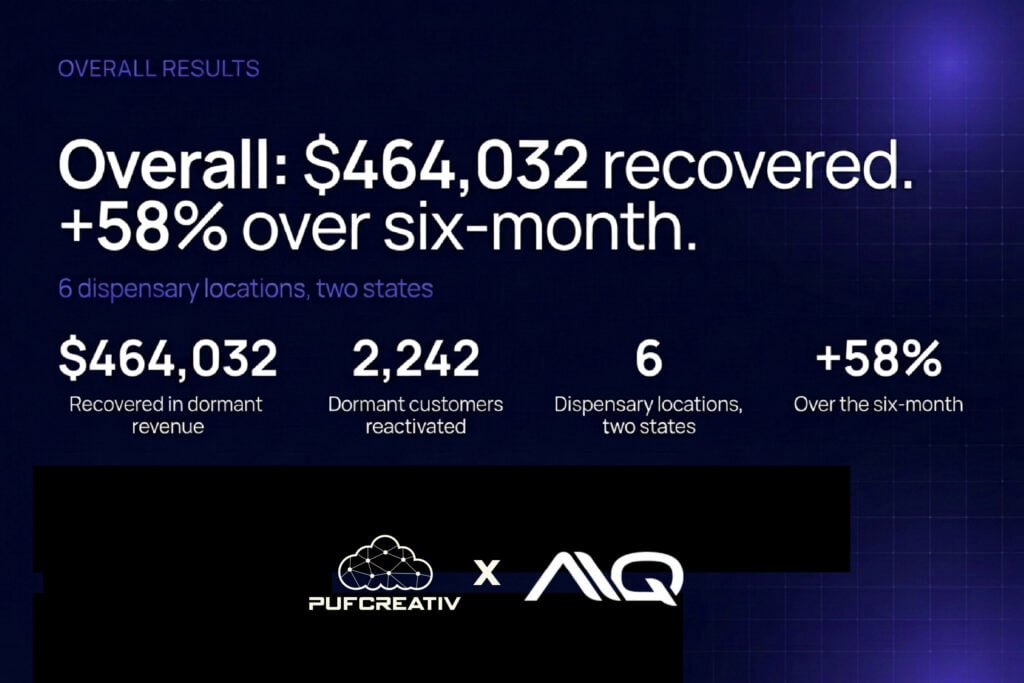
Six months later, we’d recovered $464,032 in revenue from that dormant base, beating a combined forecast of $293,000 by 58% and reactivating 2,242 customers.
Here’s how we built the program and why we got such good results.
How We Built a Win-Back Program on Existing Customer Data
Why Unified POS and Loyalty Data Made Segmentation Possible
We run every client on AIQ. This operator had already onboarded their loyalty data there, connecting it directly to POS in all six stores. This step was critical to the solution. Most win-back programs stall out because loyalty data sits on one platform and purchase history on another. Nobody wants to spend months indexing information. Every customer’s data was resolved in one clean profile through AIQ with this operator. We could see exactly who stopped buying, when they made their last purchase, and what they typically spent without compiling the information ourselves.
That let us skip straight to the work that drives sales: figuring out who to talk to and what to say.
Segmenting Dormant Customers by Days Since Last Purchase
A customer who last bought two months ago and a customer who hasn’t purchased in three years aren’t likely to respond to the same message. So we split the full 66,000-customer base into five lapse windows: 60 to 90 days, 91 to 120, 121 to 180, 181 to 365, and over a year of no activity. Each segment got its own revenue forecast and its own campaign approach.
A light discount can nudge back a recently lapsed customer. Someone who’s been gone for a year often needs a stronger reason to return.
Running State-Specific Win-Back Campaigns in Massachusetts and Connecticut
We also chose not to run the same campaign across both states. Massachusetts and Connecticut have different customer bases, purchase patterns, and regulatory environments. We built separate forecasts and execution plans.
Rather than assuming the same approach would work in both states, we tailored our campaigns to each market.
The Results: $464,032 Recovered Against a $293,000 Forecast
- Massachusetts: $369,410 recovered, 65% over forecast
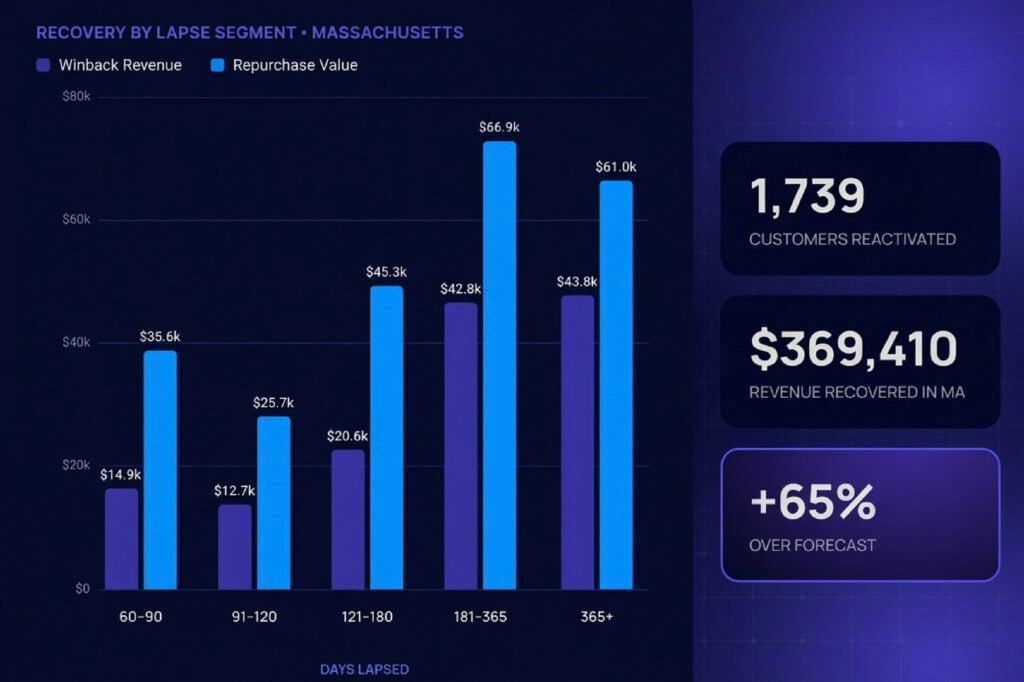
Across the four Massachusetts stores, we recovered $369,410 against a $223,000 forecast. We beat the target by 65% and brought back 1,739 customers. - Connecticut: $94,622 recovered, 35% over forecast
The two Connecticut stores added $94,622 against a $70,000 forecast, a 35% beat, reactivating another 503 customers.
Combined, that’s $464,032 recovered against a $293,000 six-month target.
Even Customers Lapsed Over a Year Came Back
The segment breakdown told its own story. In Massachusetts, customers who hadn’t bought for over a year generated $43,846 in recovered revenue from 581 people. That figure almost matched the 181-to-365-day segment. Long-dormant customers aren’t unreachable; they need a program tailored directly for them. One customer’s last purchase was in April 2021. He came back in April 2026, five years later, and spent $67.41.
The point is, a well-run win-back program treats “dormant” loyalty status as temporary.
Why This Didn’t Require New Technology
This is the part worth sitting with if your loyalty database looks anything like this operator’s did. We didn’t build custom integrations or ask the client to adopt new software. Their AIQ account already included deduplicated profiles, POS-connected purchase history, and compliant SMS and email infrastructure. The only thing missing was someone with the time to audit 66,000 records and build forecasts by state and by lapse segment. Someone also needed to run six months of coordinated campaigns across two states and six stores.
Most retailers don’t have a team with the bandwidth to take on a project like this on top of day-to-day operations. That’s the gap PufCreativ fills for operators running multiple locations.
FAQs
- What is a win-back campaign for dispensary loyalty customers?
A win-back campaign targets loyalty members who stopped purchasing, using segmented messaging based on how long they’ve been inactive to bring them back to the store. - Can you recover revenue from customers who haven’t purchased in over a year?
Yes. In this case, customers lapsed over a year generated $43,846 in recovered revenue from 581 people in Massachusetts alone, nearly matching a more recent lapse segment. - Do I need new software to run a win-back program on AIQ?
No. If your loyalty and POS data already live in AIQ, the infrastructure is already there. What’s usually missing is the time to audit the data and run the campaigns. - How long does a win-back program take to show results?
This program ran for six months, from December 2025 through June 2026, and produced measurable revenue recovery across all six store locations. - Why run separate campaigns for different states instead of one combined campaign?
Customer bases, purchase patterns, and regulations differ by state. Separate forecasts and execution plans let each market perform against its own realistic target instead of an average.
How to Find Dormant Revenue in Your Own Loyalty Database with PufCreativ
If you’re running loyalty on AIQ and have customers who haven’t purchased in 60 days or more, that uncounted revenue is likely sitting in your account. The data is there; it just needs a plan and someone to run it.
Ready to see what’s dormant in your own database? Get in touch with our team, and we’ll show you what a win-back audit looks like for your stores.
DISCLAIMER: The results described in this case study reflect one operator’s experience and are not guaranteed for every business. Revenue outcomes depend on factors such as customer base size, market conditions, campaign execution, and regional regulations. Past performance does not guarantee similar results for other retailers.