
As is true of most things in this life, it’s the details that matter.
In cannabis, your website is the heartbeat of your brand. It’s where customers discover you, trust you, and decide if they’re sticking around or bouncing to the shop down the street. But here’s the catch: designing a cannabis website that actually converts and stays compliant is a different game entirely. Between strict advertising rules, SEO hurdles, and tech limitations from third-party platforms, most sites end up beautiful but invisible or fast but fragile.
In this blog, I’ll break down the must-know components of high-performing, cannabis-friendly web design.
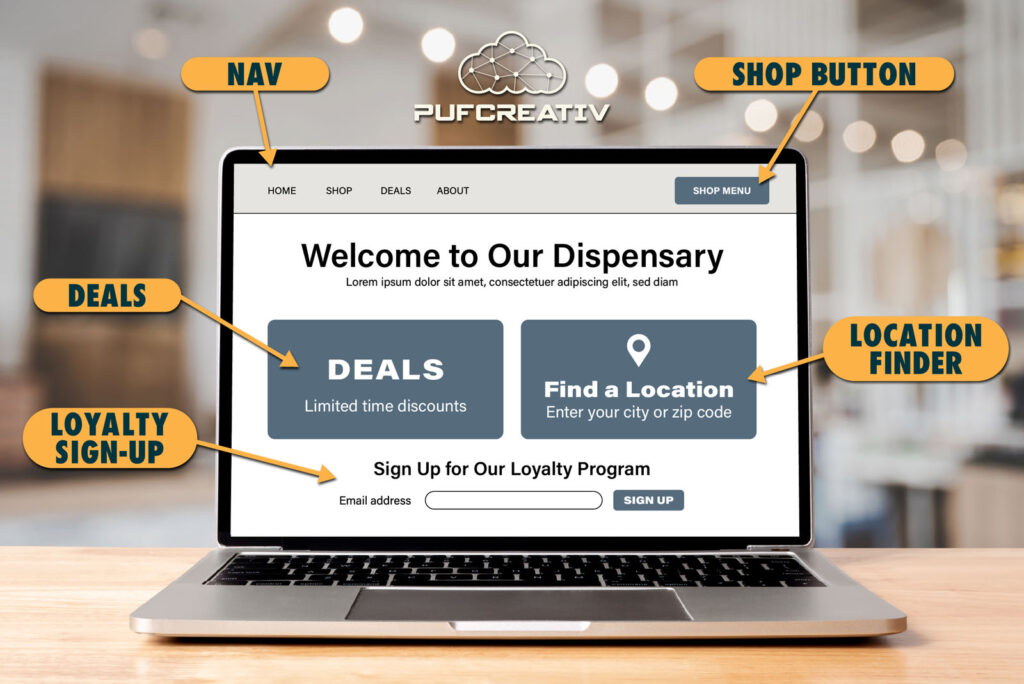 Structure First: Build for Google & Real Users
A properly structured site (meaning proper headline hierarchy, navigation structure, and a consistent layout) not only makes it easy for Google to index your site, but it also clearly and quickly guides users to what they are looking for. And when you take special care to optimize the mobile experience (which makes up the vast majority of internet users), it shows when users are able to find your products and check out within a matter of clicks.
In this day and age of diminishing attention spans, streamlining the user experience is of the utmost importance. And on top of a quick and easy-to-use UX, when your site loads quickly, it really is the icing on the cake.
When all of these things come together, users leave happy.
Why Cannabis Menus Create an ‘SEO Problem’
One quirk of the cannabis industry is that—for any and all online shopping for THC products, it’s all handled via a third-party menu provider—such as Alpine IQ, I Heart Jane, Trees, Blaze/Tymber, or Dutchie. Since this is the case, many of these menus are embedded in your site via an iFrame, which essentially is a small snippet of code to place an external website (your menu POS) within your website itself.
While this is very quick to set up and gets users shopping sooner than later, there are many drawbacks when it comes to SEO and the capabilities of an iFrame. Because your products live on the external menu POS site, they don’t appear in your sitemap—the framework Google uses to index your website.
This leaves you missing out on hundreds, if not thousands of pages of SEO potential, including the products themselves, but also brand archives, category archives (flower, pre-rolls, concentrates, etc.), and much more.
Native Menus & Reverse Proxy: The SEO Unlock
An increasing number of menu POS providers are offering reverse proxy (yes I know that’s gibberish to most of you) functionality that allows you to have a native e-commerce menu within your website (and subsequent sitemap) itself.
Long story short, this eliminates the iFrame sitemap issue outlined above and places each and every product within your sitemap, which means every single product that you upload into your POS dashboard will not be syncing directly to your site, and catching Google’s eyes because of it. While this can be more expensive and intricate to set up, the long term benefits are night and day compared to a simple iFrame.
Instead of losing SEO value by hosting products on the POS domain, you bring every product onto your own site and into your sitemap. Google can then index those pages and track signals like time on page, clickthrough rates, bounce rates, conversions, and more.
SEO Starts Before Design Starts
As mentioned earlier, the sum of the whole consists of many small details, and when you have SEO at the forefront of your approach from the beginning of the website development phase, it pays off in the long run. I could talk for days about how interwoven development and SEO are, but it truly starts at the very beginning of the website project phase, including the design of the site itself.
Consider hierarchical layouts with clear headline structure, short blocks of copy, and a balanced number of CTAs from the moment your designer puts pen to paper. Load times matter too, especially if you’re embedding video (which comes with large file sizes). More than one video per page can slow things down quickly.
Too many transparent PNGs or WEBM images can bog down load times, so find a balance and try not to overwhelm both the user and the server when laying things out.
Store Organization: The Hidden Growth Lever
Beyond the design, if you are developing an e-Commerce site, organization is also of the utmost importance from the very beginning. Concisely categorized and tagged items (again) not only allow Google to quickly index your site, but this lets users know exactly what they are looking for.
Redundant, repetitive, and sloppy product organization can go off the rails very quickly, so having a rock-solid plan of your online store’s flow will set you up for success.
 Build with SEO in Mind All the Way Through Dev
Lastly, once the development gets started, keep the ‘SEO state of mind’ flowing:
- Optimize all images for both their file size and file names before uploading them to the server.
- Set up parent/child pages right off the bat so you won’t need to go back and set up redirects if you have to restructure things within the sitemap.
- Clean up working drafts and avoid duplicate pages and posts.
- Loop in your copywriters as soon as possible to start optimizing your metadata, headlines and body copy, so you won’t need to go back and replace all the content somewhere down the line.
All of this seems very nitpicky (and it is!) but if you truly pay attention to every detail of the site from the start of the project, you will surely save a tremendous amount of time post-launch when you don’t need to go back and do double work.
Compliance Is Part of Performance
Compliance-wise, embedding an ADA widget is crucial when it comes to websites within the cannabis industry. Not only does this allow for quick and easy on-page accessibility options such as contrast adjustment, larger text sizing, and a variety of other features, many of these features regularly perform audits of your site and alert you to areas that need improvement from a compliance perspective.
With cannabis still being federally illegal, our industry is constantly under fire from a variety of outside forces. Therefore, when there are low hanging non-compliant elements of your site, it’s only a matter of time before you get flagged and penalized.
Additionally, each state has its own verbiage compliance you must adhere to. Whether that includes using “adult use” or “recreational,” “marijuana” or “cannabis,” or even using the word “deals” or “specials” to alert users of on-sale products, staying up-to-date on your state’s current regulations pays off in the long run.
Our industry is constantly evolving (and devolving in some cases), so staying diligent with keeping your site compliant will be an ongoing battle until further notice.
PufCreativ Is Serving Up High-Converting Cannabis Websites
If you’re ready for a website that ranks, converts, and stays compliant, be sure to reach out to PufCreativ. Let’s build something your customers (and Google) will love!
 Ben Stewart – Director of Web
You can always count on Ben Stewart to get the job done right, no matter the circumstances. He is the Director of Web at PufCreativ and the founder of both the web and SEO departments. With a background in graphic communications and computer science, Ben naturally gravitated toward web development and SEO early in his career. Over the years, he has helped build a rock-solid web team known for crafting websites that are as beautiful as they are bulletproof. While he has since passed the SEO torch to others, his deep knowledge continues to guide the work.
Ben’s proudest accomplishment is not just one site or project, but the collective quality and reliability of everything the team has produced. Based in Montana, Ben lives for fresh air, quiet mountains, and wild rivers. He spends his free time fly fishing, snowboarding, hunting, and adventuring with his wife two high-energy dogs, Charlie and Roo. He is equally at home writing code or rewiring a light fixture, bringing both precision and versatility to every part of his life and work.
About Us • PufCreativ • Cannabis Advertising Agency & Marijuana Marketing